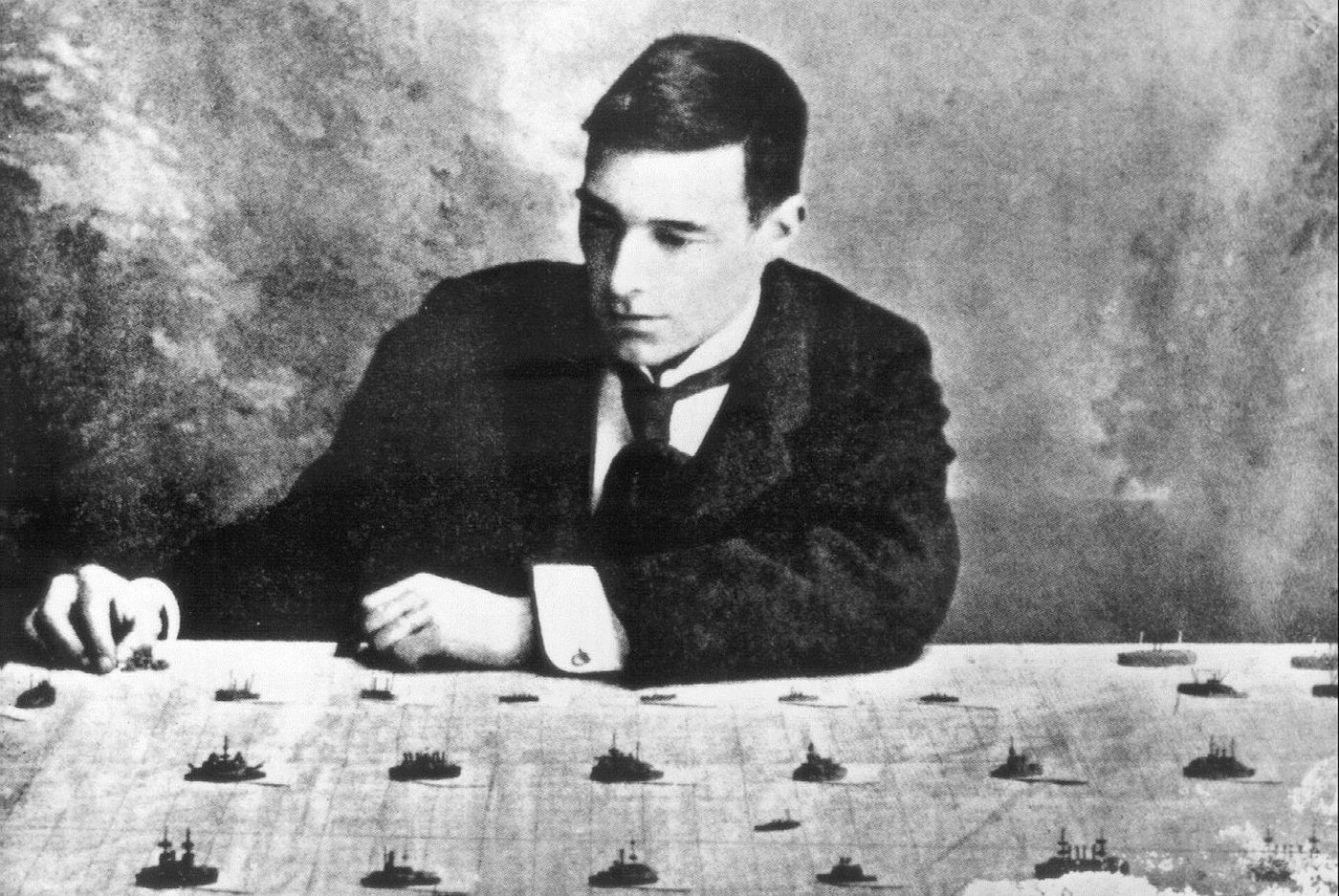
If you’ve ever seen a navy expert on the news quoting “Jane’s”, you’ve met the legacy of one of Southsea’s greatest eccentrics. The Fred T Jane Southsea story has it all: warships, war games, science fiction, a failed election campaign and the time he kidnapped an MP. Seriously, you couldn’t make it up.
From Devon to Southsea
John Frederick Thomas Jane was born on 6 August 1865 in Richmond, Surrey, the son of a vicar, and grew up in Devon, where he went to Exeter School. Even as a boy he was obsessed with ships, and by some accounts with explosives too: one school story has him trying to blow up the chemistry lab.
He became an illustrator, drawing warships for magazines, and a writer of science fiction, with novels including To Venus in Five Seconds (1897) and The Violet Flame (1899). After a hard spell in London, where he was said to be “next door to starving”, he moved to Southsea in 1897. It was the making of him, and the start of the Fred T Jane Southsea years that would make his name famous far beyond Pompey.
17 Elphinstone Road and the birth of Jane’s
From 1898 to 1911 he lived at 17 Elphinstone Road, Southsea. It was here that he produced the book that made his name: All the World’s Fighting Ships, first published in 1898. It was renamed Jane’s Fighting Ships in 1905 and went on to become one of the best known naval reference books in the world.
He didn’t stop there. In 1909 he launched All the World’s Air-Ships, which later became Jane’s All the World’s Aircraft. He also wrote a regular column for the Hampshire Telegraph, and he invented a naval war game, presenting it to the Royal United Services Institute in 1898.
A blue plaque on the house today reads “Fred T Jane 1865-1916 Naval Author, Artist and Propagandist lived here 1898-1911”. It went up in July 2004 as part of English Heritage’s pilot scheme for plaques outside London.
The Fred T Jane Southsea eccentric
This is where it gets fun. Jane was, by every account, a character:
- The election: in 1906 he stood for Parliament in Portsmouth as an independent, on a “Navy Before Party” ticket. He came bottom of the poll.
- The kidnapping: during the 1909 Labour conference in Portsmouth, he “abducted” the MP Victor Grayson by car and drove him off to Petersfield. Grayson never gave his speech.
- The motoring: a keen early motorist, he reportedly talked his way out of a speeding charge by claiming he was racing to avoid running out of petrol.
- The Scouts: he helped set up one of the early Scout troops and organised motorised Scout field days, including a mock attack on Fareham in 1910.
Can you imagine the headlines today? He’d be all over TikTok. In a city full of naval officers and serious-minded dockyard folk, the Fred T Jane Southsea antics must have been quite the talk of the town, and he clearly loved every minute of it.
Final years and resting place
After a spell at Bedhampton, he moved back to Southsea, to 26 Clarence Parade. He died there on 8 March 1916, aged just 50, of heart failure after influenza. That house was later destroyed by German bombs, but a plaque at the corner of Palmerston Road and Clarence Parade marks the spot where he spent his last years.
He’s buried in Highland Road Cemetery, Southsea, with his first wife Alice. The trail is easy to follow on foot: start at Elphinstone Road, wander down to Clarence Parade, then head east to Highland Road Cemetery.
Jane’s today
More than a century after his death, the name lives on. The company, now styled simply as Janes, provides open source intelligence on defence, security and aerospace around the world. Its owners have changed over the years, but the name Jane’s has carried on for well over a century. Not bad for a book that started life in a Southsea front room.
Why Fred T Jane Southsea history matters
Portsmouth has always been a Navy city, so it feels right that the world’s most famous guide to warships was born here. Jane took his obsession with ships, mixed it with a showman’s flair, and built a name that’s still known around the world today. And he had a cracking time doing it.
Next time you’re walking down Elphinstone Road, look out for the plaque and raise a cuppa to the most eccentric naval expert Pompey ever had.
Love this sort of thing? See my list of famous people from Portsmouth, read about Kipling and Wells in Southsea, and explore the ships themselves at the Historic Dockyard. Check the What’s On calendar, submit an event, and sign up for Good Morning Dinlos. 💙⚓
Sources: Wikipedia: Fred T. Jane, Star and Crescent: The Case of the Naval Expert and the Missing MP, Exeter Memories: Fred T Jane, Memorials in Portsmouth: Elphinstone Road plaque, Memorials in Portsmouth: Clarence Parade plaque, Portsmouth City Council: blue plaques, Royal Geographical Society: pilot scheme plaques, Grace’s Guide: Jane’s Publishing, Wargaming Miscellany: Fred Jane, Wikipedia: Janes.